Quick Answer
Yes. Many common health problems, including high blood pressure, type 2 diabetes, high cholesterol, early kidney disease, anaemia, and early cancers, can develop for months or even years without symptoms. Routine health checks find these conditions early, when they are easier and less costly to treat. A check-up does not create a problem. It only shows what is already there.
Why Do Silent Health Problems Go Unnoticed?
Some of the most common health problems develop quietly. You keep working, looking after your family, and sleeping well, while something builds up in the background.
In my work with patients, I hear the same reasons for skipping check-ups again and again. One is, "If it's not broken, don't fix it." Another very common one is, "If you go to the doctor, they will always find something, abeg."
I understand that last worry. Nobody wants bad news. But a check-up does not create a problem. It only shows what is already there. It is far better to find something while it is small than to wait until it finds you, because by the time a silent condition causes symptoms, it is often harder and more costly to treat.
Which Health Conditions Often Have No Symptoms?
- High blood pressure (hypertension): Most people feel nothing while it strains the heart, kidneys, brain, and eyes. It is a leading cause of stroke.
- Type 2 diabetes and prediabetes: Blood sugar can rise for years before thirst, tiredness, or frequent urination appear.
- High cholesterol: You cannot feel it. It builds up in the blood vessels and raises the risk of heart attack and stroke.
- Early kidney disease: The kidneys can lose much of their function before there are obvious signs.
- Anaemia: It often creeps up slowly, and the tiredness is easy to blame on a busy life.
- Early cancers: Changes in the cervix, breast, or prostate often cause no pain at first. Screening finds them when treatment works best.
- Glaucoma: It slowly damages side vision, and sight lost to glaucoma cannot be restored.
- Tooth decay and gum disease: These are often painless until they are advanced.
How Do You Prepare for a Health Check-Up?
- Ask about fasting. Some blood tests need you to avoid food for 8 to 12 hours. Water is usually fine. Confirm when you book.
- Bring your medicines. List everything you take, including supplements and herbal remedies.
- Know your family history. Find out whether your parents or siblings have had high blood pressure, diabetes, heart disease, or cancer.
- Bring past results. They help your doctor see what has changed.
- Note small changes. Waking at night to urinate or feeling more tired than usual may seem minor, but mention it.
- Write down your questions. Good ones to start with are: What do my results mean? What should I do next? When should I come back?
- Plan your timing. Avoid booking cervical screening during your period, and ask whether an eye exam will blur your vision for driving.
What Should You Do After Your Check-Up?
A test only helps if you act on the result. A pattern I see often is this: a patient has a borderline reading and is asked to return in three months, but comes back a year later. By then, "let's watch this" has become "let's treat this."
- Understand your results. Ask what each number means for you, not just whether it is "normal."
- Book follow-ups before you leave. If you need a repeat test or a specialist, set the date there and then.
- Keep a simple record of your key numbers so you can see the trend.
- Do not panic over one abnormal result. Many results need confirmation with a repeat test.
- Back it up with daily habits. Move more, eat more vegetables, cut back on salt and sugar, sleep well, and avoid tobacco.
The Bottom Line
We often say health is wealth, but some of us haven't checked our balance in years. Your car gets serviced, your phone gets updates, and even your generator gets attention. You deserve at least the same.
Pick one check you have been putting off and book it this month.
Reach us on WhatsApp at 0909 399 5002, call +234 201 700 0843, or visit www.eha.ng.
Frequently Asked Questions
Can you have a serious health problem without any symptoms?
Yes. High blood pressure, type 2 diabetes, high cholesterol, early kidney disease, anaemia, early cancers, glaucoma, and gum disease can all develop for months or years before causing noticeable symptoms. Routine checks are the main way to find them early.
Why are routine health checks important?
Routine checks find silent conditions while they are small and easier to manage. They also give you and your doctor a baseline, so changes in your numbers can be spotted over time.
What health checks should adults have regularly?
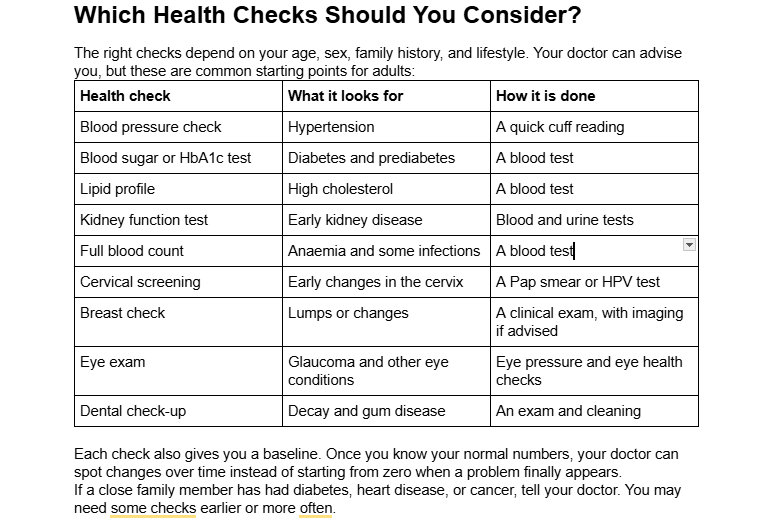
Common starting points include a blood pressure check, blood sugar or HbA1c test, lipid profile, kidney function test, full blood count, cervical screening, breast check, eye exam, and dental check-up. Your doctor will advise which ones you need based on your age, sex, family history, and lifestyle.
How often should I have a health check-up?
This depends on your age, risk factors, and family history. If a close relative has had diabetes, heart disease, or cancer, you may need some checks earlier or more often. Ask your doctor to set a schedule that suits you.
Do I need to fast before a health check-up?
Some blood tests need you to avoid food for 8 to 12 hours, and water is usually fine. Confirm with the clinic when you book.
What should I do if one of my results is abnormal?
Do not panic. Many abnormal results need confirmation with a repeat test. Ask your doctor what the result means for you, what to do next, and when to come back.
Will a doctor always find something wrong during a check-up?
No. A check-up does not create a problem. It only shows what is already there. If everything is normal, you get peace of mind and a baseline for the future.
By
Salewa Salaudeen
Clinical Services Operations Manager, EHA Clinics Nigeria