
.jpeg)
Power is one of the most critical, yet often overlooked, components of healthcare delivery. In many parts of Nigeria, inconsistent electricity supply continues to disrupt essential services — and for our patients, that can mean delays, rescheduled appointments, or interruptions in care. For healthcare providers, it creates daily uncertainty in environments where precision and timeliness are non-negotiable.
At EHA Clinics in our Kano branch, this challenge is being addressed through a deliberate shift toward reliable, sustainable energy. The full solarization of the Lamido facility marks a significant step in rethinking how healthcare can be delivered without interruption, without compromise, and with patients at the centre. More than a facility upgrade, it represents a practical model for climate-resilient healthcare — one that speaks to what is possible across Nigeria's health system.
Operational Impact: Stability Where It Matters Most
With a fully solar-powered system now in place, the Kano facility operates with a level of consistency that was previously difficult to guarantee. Critical services such as laboratory diagnostics, vaccine storage, and routine consultations can run without interruption, regardless of external power conditions. For healthcare workers, this stability removes a layer of uncertainty, allowing them to focus fully on patient care rather than contingency planning.
For patients, the difference is tangible. Shorter wait times, fewer rescheduled appointments, and a more predictable care experience all contribute to better health outcomes and increased trust in the system. In a setting where access to quality healthcare is already a challenge for many, reliability becomes more than an operational advantage — it becomes a defining part of care itself.
A Measurable Climate Commitment
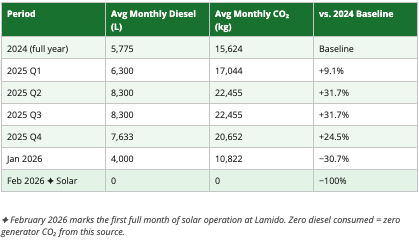
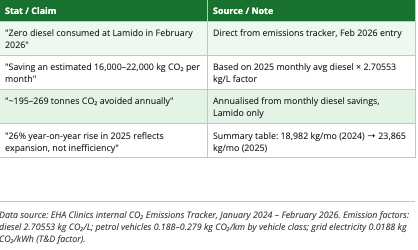
The shift to solar is not only good for patients — it is measurable in its environmental impact. Prior to solarisation, the Lamido Clinic was consuming an average of approximately 6,000 to 8,000 litres of diesel per month to power backup generation. Each litre of diesel burned produces roughly 2.7 kg of CO₂, meaning the facility was responsible for an estimated 16,000 to 22,000 kg of CO₂ emissions per month from generator use alone.
The data tells a clear story of what changed. In February 2026 — the first full month of solar operation — Lamido recorded zero litres of diesel consumed. That single month represents an estimated saving of over 16,000 kg of CO₂ compared to the facility's 2025 average. Projected over a full year, the solar transition at Lamido alone is on track to prevent more than 195,000 kg — or approximately 195 tonnes — of CO₂ emissions annually.
This is a significant figure in the context of Nigeria's healthcare sector, where diesel dependency remains the default response to an unreliable grid. The Lamido transition demonstrates that a viable, cleaner alternative exists — and that the health sector does not have to choose between reliable care and responsible environmental stewardship.
Part of a Larger Sustainability Picture
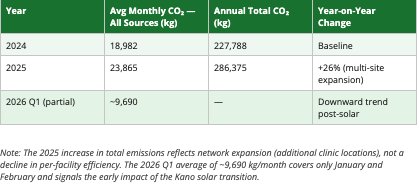
Across EHA Clinics' network, emissions data have been tracked since January 2024 across diesel consumption, vehicle fleets, and grid electricity use. The organisation's total CO₂ footprint grew from an average of 18,982 kg per month in 2024 to 23,865 kg in 2025 — a 26% increase that reflects deliberate network expansion into new locations, rather than reduced efficiency. With the Kano solar transition now reducing one of the highest-emitting drivers in the portfolio, the trend line is beginning to reverse.
By investing in solar energy, EHA Clinics is not only addressing an immediate operational need but also contributing to a more sustainable and resilient healthcare model. As climate pressures and energy challenges continue to intersect, solutions like this offer a practical pathway for strengthening healthcare delivery across Nigeria — one facility, and one community, at a time.
*Emissions figures are derived from EHA Clinics' internal CO₂ tracking data (2024–2026), using standard diesel emission factors of 2.70553 kg CO₂/litre.
1. Lamido Clinic — Diesel Generator Emissions (2024–2026)
Diesel remains the primary source of backup power across EHA Clinics locations. The table below shows monthly average diesel consumption and associated CO₂ output at the Lamido Clinic before and after solarisation
2. Projected Annual Savings from Solar Transition
Based on Lamido's 2025 average monthly diesel consumption of approximately 6,300–8,300 litres, the following projections apply if zero diesel consumption is sustained:

3. Network-Wide Emissions Overview (All Sources)
Total CO₂ is tracked across three emission categories: diesel generators, vehicle fleet, and grid electricity. The table below summarises annual and quarterly performance.
4. Key Figures for Communications Use
.png)