
.png)
The Problem Every Nigerian Pharmacist Knows
Ask any pharmacist working in Nigeria — in a community pharmacy in Kano, on a hospital ward in Lagos, or in a dispensary in a secondary city — and they will describe the same quiet pressure: practising in one of the world's most complex healthcare environments, often with reference tools designed for another country entirely.
Drug references built for US or UK markets. Dosing guides that reference pack sizes they don't stock. Pricing in currencies that their patients don't use. Clinical guidelines that don't reflect local disease burden, available generics, or the realities of the Nigerian supply chain.
This is not a minor inconvenience. It is a patient safety issue — one that contributes daily to misdiagnosis, wrong dosing, unrecognised drug interactions, and the continuation of outdated treatment protocols across Nigeria and West Africa.
Pharma West Africa 2026: Where the Future Was Written in Real Time
At the Pharma West Africa Exhibition in Landmark Hotel Lagos, over three days, industry leaders, regulators, innovators, and practitioners gathered to confront the most urgent challenges facing pharmaceutical practice in the region — and to do something about them.
The conversations were honest and ambitious. Supply chain fragility. The dangers of substandard and falsified medicines. The gap between pharmaceutical innovation and public health delivery. The urgent need for local manufacturing capacity, digital transformation, and stronger pharmacovigilance systems.
It was against this backdrop — a room full of people who understood the stakes — that RXBook made its debut.
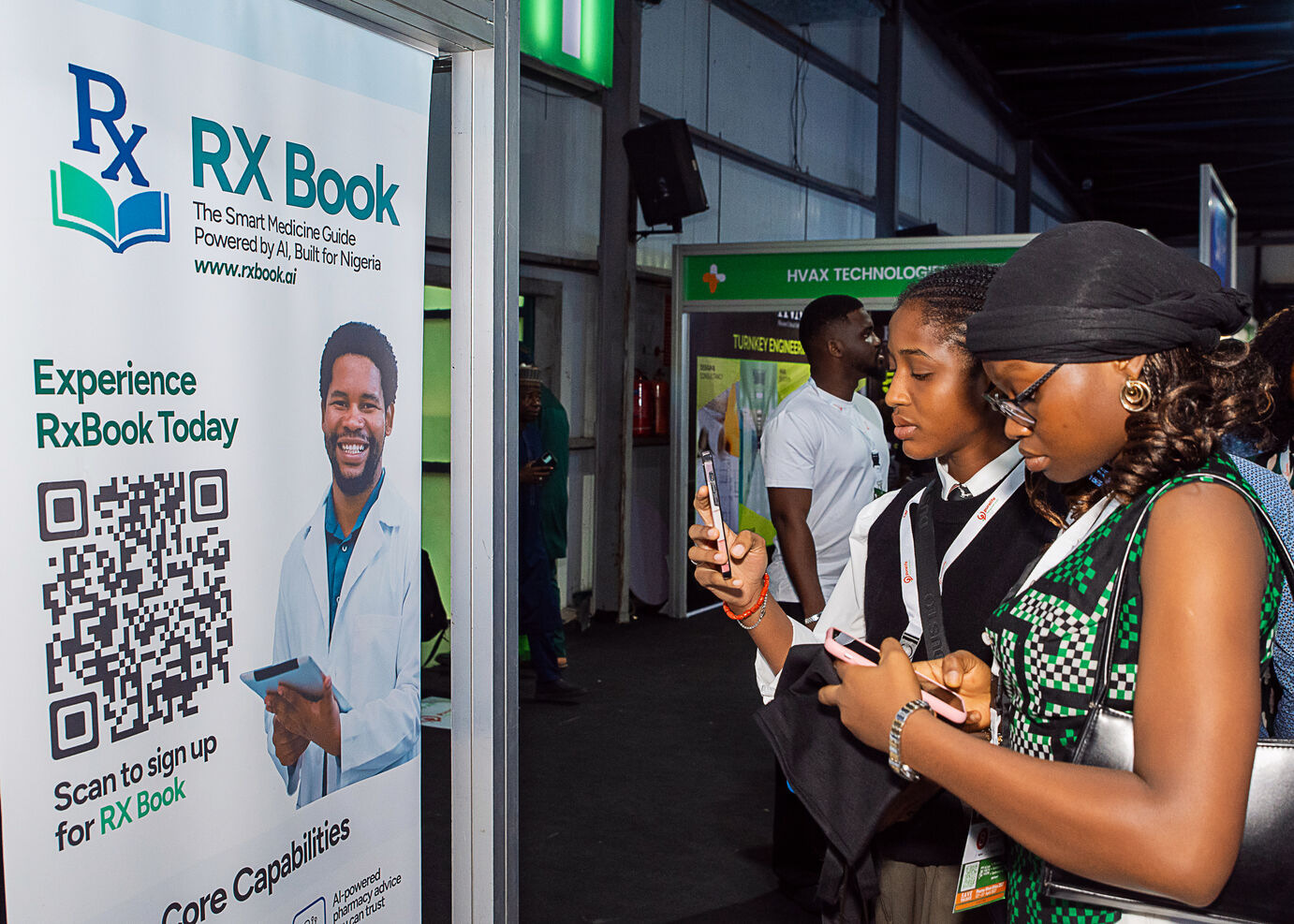
Introducing RxBook: The Smart Medicine Guide Built for Nigeria
Developed through a deliberate collaboration between Pharmaplus Pharmaceuticals Ltd, EHA Pharma, and eHealth Africa, RXBook is Nigeria's first AI-powered digital medicine reference — a clinical tool built not for a generic global market, but specifically for the Nigerian pharmacist, in the Nigerian context, for Nigerian patients.
At its core, RXBook is a digital formulary that, as its creators put it, thinks like a Nigerian pharmacist.
What RXBook Does
Complete Nigerian Drug Database: Every drug legally prescribable in Nigeria — generic and branded — is searchable within the platform. No more consulting references that list medications unavailable in Nigeria or omit the generics that form the backbone of daily practice.
Nigeria-Specific Dosing Guidance Dosing guides are calibrated for Nigerian practice: weight-based, renally and hepatically adjusted, and tailored for paediatric and geriatric patients. This is clinical decision support that reflects the patients actually sitting across the counter.
Drug Interaction Alerts Clinically validated drug-drug and drug-disease interactions, drawn from both international and Nigeria-specific sources, are surfaced in real time — reducing the risk of harmful combinations reaching patients.
AI Clinical Chatbot Connected to over 200 clinical and pharmaceutical databases, RxBook's AI chatbot gives pharmacists and clinicians instant, evidence-backed responses to complex drug queries. Every AI-generated answer passes through seven verification checkpoints: NAFDAC registration status, NHIA formulary alignment, drug interaction databases, recent recalls and alerts, Nigeria-specific clinical sources, cost-effective alternatives, and local availability. It references Naira pricing, NAFDAC-listed products, and local brand availability — because the tool is designed for where its users actually work.
Offline Functionality In a country where internet connectivity remains uneven, offline access is not a feature — it is a necessity. RXBookworks without an internet connection, ensuring that a pharmacist in an underserved area has the same access to critical information as one in central Lagos.
Live Safety Alerts: NAFDAC recalls, NHIA updates, and global drug safety alerts are pushed directly to users' devices in real time. The days of chasing circulars and missing critical recall notices are over.
Yellow Card Adverse Event Reporting When a pharmacist witnesses an adverse drug reaction, RXBook automatically generates the official NAFDAC adverse event report from a few taps — removing the friction that has for too long kept pharmacovigilance a duty more honoured in theory than in practice.
Integrated Procurement Pharmacists can search for any drug, build a cart, and request a quote directly through EHA Pharma's NAFDAC-registered, quality-assured supply network — all within the same platform used for clinical reference. Every order is automatically documented, creating an audit trail ready for regulatory review.
Coming Soon: Packshots of actual Nigerian pack sizes — not US or UK equivalents — and patient information leaflets in Hausa, Yoruba, and Igbo, shareable directly over WhatsApp.

See RX Book in the News: Guardian
What the Experts Said
The panel discussions at Pharma West Africa 2026 reinforced exactly why a tool like RXBook is needed now. Across sessions on supply chain integrity, digital transformation, and pharmacovigilance, a consistent message emerged from industry leaders: technology and innovation are no longer optional — they are the only credible path forward.
Paul Hogan, COO of EHA Clinics and EHA Pharma, put it plainly during the Day Three panel on curbing substandard and falsified medicines:
"The quicker we can embrace technology and work with it together, the quicker things will happen. Without it, it's going to take another 20 years to put anything in place."
Follow RX Book on LinkedIn
Why This Matters Beyond the Conference Room
The significance of RXBook extends well beyond Pharma West Africa 2026.
Nigeria has over 20,000 registered pharmacists serving a population of more than 200 million people. Many practise in environments with limited access to current clinical resources, unreliable internet, and supply chains that remain vulnerable to substandard and falsified products. The consequences of information gaps in this context are not abstract — they translate directly into patient harm.
RXBook addresses this at the point of care, where it matters most. A pharmacist who has the right information at the right moment makes better decisions. Better decisions reduce adverse events. Fewer adverse events generate stronger pharmacovigilance data. Stronger data support a more resilient supply chain. And a more resilient supply chain means better health outcomes for millions of Nigerians.
The chain of impact is real — and it starts with a single pharmacist opening an app.
The 6-Month Free Access Offer: An Invitation to the Profession
For a limited time, RXBook is offering six months of free access to new users — no credit card required, no catch.
This is not simply a promotional gesture. It is a statement of confidence. The teams behind RXBook believe that once pharmacists and healthcare professionals use the platform, they will not want to practise without it. The free access period is an invitation to experience that firsthand.
→ Visit www.rxbook.ai to download the app and claim your free access.
RXBook is a product of a collaboration between Pharmaplus Pharmaceuticals Ltd, EHA Pharma, and eHealth Africa. As reported by The Guardian, Vanguard, BusinessDay, and Daily Trust.
Tags: RxBook, Digital Health Nigeria, EHA Pharma, Pharmaplus, eHealth Africa, Pharma West Africa 2026, Nigerian Pharmacist, Drug Reference App, AI in Healthcare, Pharmacy Technology Nigeria, NAFDAC, Pharmaceutical Innovation West Africa, Medicine Safety Nigeria
.jpeg)
.png)